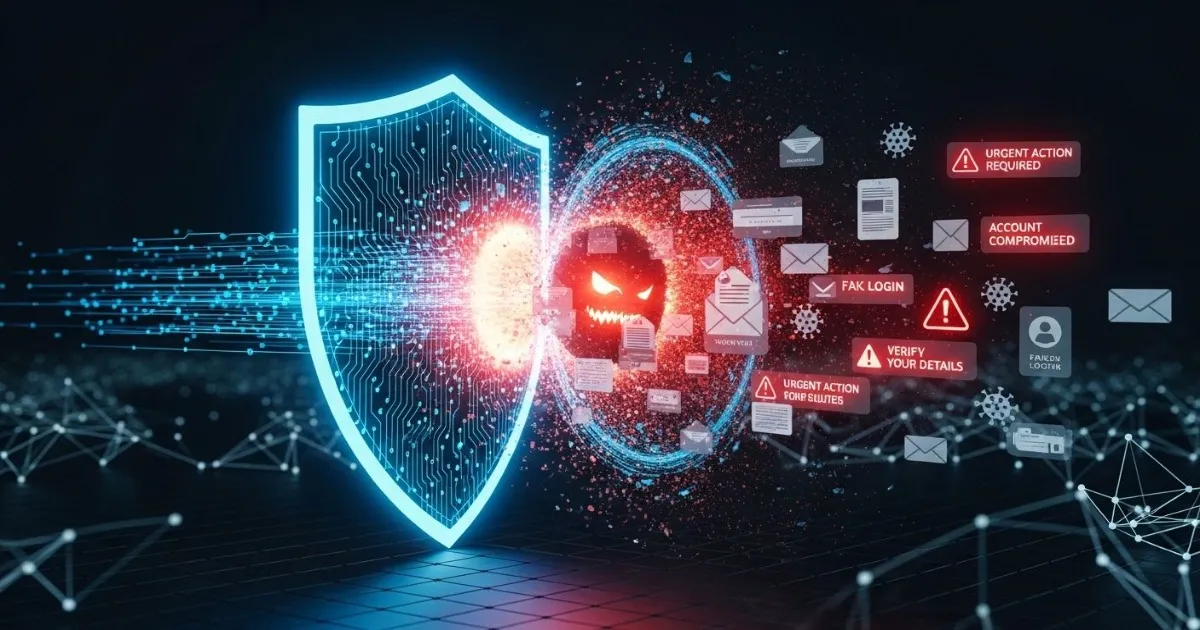
This analysis is based on public threat intelligence reports, academic research, and cybersecurity industry data published between 2025–2026.
Remember when phishing emails were easy to spot? The awkward grammar, the mismatched logos, the urgent requests from "Nigerian princes" promising millions. Those obvious scams almost felt comforting—they were so clumsy that falling for them seemed impossible.
That era is over.
Recent threat intelligence reports indicate that AI-powered phishing attacks now occur at a staggering pace—one attack every 19 seconds, more than doubling from 2024's rate of one every 42 seconds. This isn't just an increase in volume; it's a fundamental transformation of what phishing looks like and how dangerously convincing it has become.
The same AI breakthroughs that power helpful chatbots and productivity tools are now being weaponized by cybercriminals. The result is a perfect storm: attacks that are grammatically flawless, contextually accurate, and eerily personal. They mimic colleagues, brands, and even your own writing style. They adapt in real-time based on your device and behavior. And they're getting past traditional security measures at an alarming rate.
This guide explores the new reality of AI-powered phishing and what you need to know to protect yourself in 2026.
Quick Summary
AI-powered phishing in 2026 is characterized by hyper-personalized lures, polymorphic attacks that evade detection, deepfake video and audio impersonation, and autonomous "Agentic AI" that can execute multi-stage fraud without human supervision. Protection requires a combination of skepticism, verification through separate channels, and AI-driven security tools.
Part 1: The Scale of the Threat
To understand what we're facing, consider the numbers. According to Cofense's latest threat intelligence report, 2025 marked a watershed moment in cyber defense: AI-powered phishing accelerated to the point where a malicious email attack now lands every 19 seconds. This dramatic escalation reflects how AI has shifted phishing from a periodic nuisance to a continuous, adaptive threat.
The economics of cybercrime have fundamentally changed. AI is no longer an experimental tool for attackers but rather an operational requirement that enables them to generate, test, and deploy campaigns at unprecedented speed and scale. What once required a team of human operators can now be automated, allowing small groups of attackers to run sophisticated operations that would have required nation-state resources just a few years ago.
The financial impact is equally staggering. Deloitte's Center for Financial Services projects that Generative AI could facilitate fraud losses reaching $40 billion by 2027 in the United States alone. This projection reflects not just more attacks, but more successful ones—attacks that bypass traditional defenses and fool even careful users.
Part 2: How AI Has Transformed Phishing
From Mass Emails to Hyper-Personalized Attacks
Traditional phishing cast a wide net, sending the same generic email to millions of recipients and hoping for a tiny percentage of clicks. AI has fundamentally changed this model.
Attackers now leverage publicly available data—social media profiles, corporate websites, data breaches—to craft messages that feel personally written for each target. An AI model can scan someone's LinkedIn profile, recent tweets, and professional history, then generate a convincing email that references a real project, a genuine connection, or an actual conference they recently attended.
According to Varonis Threat Labs, AI-powered phishing emails are now "near flawless, contextually accurate, and eerily personal." The old red flags—typos, awkward phrasing, generic greetings—have largely disappeared. These messages read like they were written by a native speaker who knows you personally.
The Rise of Polymorphic Attacks
One of the most significant developments is the emergence of polymorphic attacks—phishing campaigns that constantly change to evade detection. Cofense's research reveals that 76% of initial infection URLs identified in phishing attacks were unique and had not appeared in any other campaigns across their customer base. Similarly, 82% of malicious files had unique hashes, rendering traditional signature-based detection useless.
Think of it this way: every phishing email you receive could be the only one of its kind in existence. Attackers use AI to generate thousands of unique variants of the same attack, each one slightly different in wording, formatting, or structure. This shape-shifting approach means that by the time security researchers identify and block one version, hundreds of others are already circulating.
Adaptive Phishing Pages
The evolution extends beyond emails to the phishing pages themselves. Modern AI-powered attacks deploy dynamic websites that deliver different payloads based on the victim's browser, operating system, and device characteristics.
A single phishing site might:
- Deliver a Windows executable to PC users
- Send a macOS package to Mac users
- Present an optimized credential harvesting page to mobile visitors
These adaptive pages can even detect security tools and redirect analysts to legitimate websites, actively evading investigation. The phishing site you see might look completely different from what an actual victim experiences. Research from Palo Alto Networks confirms that "runtime assembly" methods can evade traditional network filters, with AI assembling phishing pages in real-time based on the victim's characteristics.
Part 3: Real-World Examples of AI-Powered Phishing
The Google Cloud CAPTCHA Attack
Security researchers at Sublime recently documented a sophisticated phishing campaign that demonstrates the new capabilities at attackers' disposal.
In this attack, adversaries abused Google Cloud's Application Integration platform to send authenticated emails from noreply-application-integration@google.com—a legitimate Google domain that passes all authentication checks. The emails appeared to be missed call notifications, complete with fake phone numbers.
When recipients clicked the links, they were directed to a CAPTCHA page hosted on Google Cloud Storage. Here's where AI came into play. Based on the structure and code comments in the HTML and embedded JavaScript, researchers believe the CAPTCHA page was entirely LLM-generated.
The CAPTCHA system was remarkably sophisticated. It featured multiple challenge types—matching, dragging, sequencing, sliding—and included bot detection mechanisms that checked for headless browsers, automation frameworks, and impossibly fast completion times. Attackers could configure exactly how many challenges a target needed to complete, effectively filtering out automated security tools while letting human victims through. Only after successfully completing these AI-generated CAPTCHAs would users reach the actual credential harvesting page.
This attack illustrates a troubling trend: attackers are using AI not just to write emails, but to build entire phishing infrastructures that leverage legitimate services and evade detection at every step.
Operation Poseidon: Nation-State AI Phishing
The stakes get even higher when nation-state actors enter the picture. In January 2026, researchers identified "Operation Poseidon," a campaign by the North Korean hacking group Konni targeting blockchain developers in Japan, Australia, and India.
What made this campaign notable was its use of AI-generated PowerShell malware. The attackers sent malicious emails disguised as financial notices, tricking recipients into downloading ZIP files containing Windows shortcuts that executed AI-crafted PowerShell loaders. These loaders deployed a backdoor called EndRAT, designed to evade detection and establish persistent access to development environments.
This represents a new frontier: AI is now being used to generate not just phishing lures, but the malware itself—code that adapts, evolves, and avoids traditional detection methods.
The $25 Million Deepfake Heist
Perhaps the most chilling example came in early 2024, when a multinational firm in Hong Kong suffered a $25 million loss in a single incident. This wasn't a technical breach or encryption failure. It was a failure of visual trust.
Attackers used deepfake technology to impersonate a CFO and multiple colleagues simultaneously during a video conference. According to the Hong Kong Police Force, the attackers used pre-recorded video manipulation to mimic participants, proving that "human-eye verification" is now a vulnerability.
As we move through 2026, such attacks are becoming more common and more sophisticated. Voice cloning now requires only a few seconds of audio—easily scraped from social media videos or voicemail greetings. Video deepfakes can be generated from a handful of photos. The technical barriers that once limited these attacks to well-funded nation-states have crumbled.
OpenAI Platform Abuse
Kaspersky recently detected a scam tactic leveraging the OpenAI platform itself. Attackers are abusing OpenAI's organisation creation and team invitation features to send spam emails from legitimate OpenAI addresses. By embedding deceptive text and fraudulent links directly into the organisation name field, scammers bypass traditional email filters and exploit user trust in a reputable service. The invitations originate from OpenAI's address, making them appear fully legitimate from a technical standpoint.
Part 4: The Technical Evolution Behind AI Phishing
Conversational Attacks and BEC
Business Email Compromise (BEC) has surged as AI eliminates traditional warning signs. According to Cofense, conversational attacks now comprise 18% of all malicious emails. These aren't simple "click this link" messages—they're ongoing conversations where attackers engage with victims over multiple exchanges, building trust before making requests.
These messages feature grammatically perfect, contextually accurate language that closely mimics legitimate internal communications. Because they're text-only, they bypass many security controls that scan for attachments or links. They exploit trust at the organizational level, often impersonating executives or vendors with whom the victim has an existing relationship.
Trustpair's 2026 Fraud Report confirms that Business Email Compromise remains the leading fraud channel, affecting 62% of organizations, followed by fake websites (48%) and text message scams (45%). The report also reveals a dangerous gap: 71% of U.S. companies have experienced an increase in AI-powered fraud attempts over the past year, yet 48% still rely on manual checks that cannot handle the scale of AI attacks.
Abuse of Legitimate Tools
Attackers have become masters of hiding in plain sight. The abuse of legitimate remote access tools exploded by 900% in volume, with attackers leveraging ConnectWise ScreenConnect, GoTo Remote Desktop, and similar IT management software as remote access trojans.
Files are hosted on trusted platforms like Dropbox and AWS, signed with valid certificates, and communicate through established domains. Every stage of the attack appears legitimate to endpoint detection systems because it uses tools and services that organizations trust and allow.
LLMs as Attack Infrastructure
Advanced attackers are now taking advantage of open-source AI models to advance their objectives. By stripping away or weakening ethical guardrails in open-source tools, self-hosted LLMs enable attackers to automate tasks where AI excels—large-scale information gathering, rapid data summarization, and adaptive retries of enumerations and exploits.
This systematic approach dramatically accelerates attack chains and lowers the barrier for sophisticated breaches, even for low-skill actors. An attacker with minimal technical expertise can now use AI to write convincing phishing lures, generate malicious code, and orchestrate multi-stage attacks that would have been impossible for them to execute just a few years ago.
Part 5: The Psychology of AI Phishing
Why AI-Generated Attacks Work
The success of AI-powered phishing isn't just about technical sophistication—it's about psychological manipulation. Attackers thrive on creating scenarios where you feel compelled to act quickly without thinking. "Your account will be suspended in 24 hours!" "Someone is trying to access your account—verify now!" "Emergency—please help immediately!" These urgent appeals bypass rational thought and trigger emotional responses.
AI makes these appeals far more effective by personalizing them. The urgency feels real because it's wrapped in language that sounds like your boss, your bank, or your colleague. The request references actual projects, real deadlines, genuine relationships.
According to Varonis, "If an email asks for credentials, money, or urgent action, confirm the request through a separate channel such as a call, text, or using the official app." This advice has never been more critical, because AI-generated emails no longer look suspicious.
The Erosion of Trust
Perhaps the most insidious effect of AI-powered phishing is the erosion of trust. When every email could be a sophisticated scam, when video calls can be deepfakes, when a message from your CEO might actually be an attacker—trust becomes a liability.
This erosion has real consequences. Organizations may find employees second-guessing legitimate requests, delaying critical actions, or hesitating to respond to genuine emergencies. The social fabric that enables efficient collaboration frays when every interaction requires verification.
Security awareness training must evolve accordingly. The old mantra of "trust what looks right" is gone. In its place is a new mindset: verify everything, especially when the request involves money, credentials, or sensitive information.
"AI has raised the baseline of fraud. The risk keeps increasing, but internal processes haven't moved fast enough. Manual callbacks and email checks simply cannot defend against attacks that are generated at scale."
Part 6: The Business Impact
Financial Institutions Under Siege
The financial sector is bearing the brunt of AI-powered phishing. Visa reports that 98% of merchants experienced one or more types of fraud in 2025. Real-time payment systems, account takeovers, and card testing have reached epidemic proportions.
Agentic AI—autonomous systems capable of perceiving, deciding, and executing multi-step actions without human supervision—is now being deployed by fraudsters. These AI agents can navigate banking onboarding flows, answer security questions, and interact with verification challenges without human intervention. They enable the automated creation of money mule accounts at unprecedented velocity.
Traditional threshold-based systems simply cannot react in the milliseconds it takes to detect and prevent this type of fraud. Real-time understanding of intent, behavior, and context has become table stakes for financial institutions.
The "Sleeper" Synthetic Identity Threat
An insidious new trend identified in 2026 is the cultivation of "sleeper" synthetic identities. Fraudsters build impeccable credit histories for these fake personas over years with small, repaid loans. Once the credit score is high, they "bust out" with massive, coordinated fraud. Detecting this requires long-term behavioral analysis to spot the subtle, unnatural patterns in an otherwise clean history.
Regulatory Response
Governments are beginning to respond. In 2025, Canada launched a National Anti-Fraud Strategy and a new Financial Crimes Agency, acknowledging that fraud is outpacing traditional defenses. Visa's Acquirer Monitoring Program (VAMP) is reshaping how payment network providers, acquirers, and merchants are judged on fraud performance, effectively turning merchant fraud levels into an enforceable obligation.
These measures underscore a broader shift: fraud prevention must evolve faster than the threats themselves. Reactive approaches that flag losses after they occur are no longer sufficient.
Part 7: Emerging Threats to Watch
Agentic AI and Autonomous Attacks
The most significant trend for 2026 is the rise of Agentic AI in cybercrime. Unlike standard generative AI, which creates content, Agentic AI can take action—perceiving environments, making decisions, and executing multi-step attacks without human supervision.
Emerging threat reports indicate that criminals are deploying autonomous AI agents capable of:
- Navigating banking onboarding flows
- Answering security questions
- Interacting with verification challenges
- Creating fraudulent accounts at scale
- Adapting tactics based on defenses encountered
This creates a machine-versus-machine conflict where speed is the deciding factor. Organizations that rely on manual review or slow, periodic checks will be overwhelmed.
Deepfake Evolution
While not new, deepfake technology has reached a tipping point. Recreating video and audio simultaneously with extraordinarily little source data is now common. A few seconds of someone's voice—from a social media video, a voicemail greeting, or a conference presentation—is enough to generate convincing audio deepfakes.
This capability enhances the success likelihood of CEO impersonations, fraud, and social engineering scams such as help-desk call-ins and external video calls. Organizations must implement additional identity verification checks for front-line employees like help desk staff and call center agents.
Injection Attacks
While media headlines focus on visual deepfakes, the technical delivery method has evolved significantly. The most dangerous vector for mobile banking in 2026 is the injection attack.
Instead of presenting a fake face to a camera (which active liveness detection can catch), attackers use custom malware and emulators to inject a digital video stream directly into the application's data pipeline. Malware families like "GoldFactory" hook into the operating system's video pipeline to steal facial data and can inject deepfakes across thousands of sessions simultaneously.
This represents an industrialization of fraud—automated scripts running at scale, targeting multiple victims at once without human operators.
Semantic Fuzzing
Security researchers have identified a technique called "semantic fuzzing" where attackers use AI to rewrite phishing lures to avoid keyword-based detection. An attacker might draft a request like "Please reset your password using the link below," then instruct the AI to "rewrite this request to avoid the word 'password' while keeping the same intent." The result: "Please validate your security profile at the link below." To a keyword-based filter, these look nothing alike. To a human—or a system that understands intent—they're the same request.
Part 8: How to Protect Yourself
For Individuals
For Organizations
- Invest in AI-Driven Security: Traditional perimeter-based and signature-driven security models are becoming obsolete against AI-powered threats. Organizations need AI-driven security for continuous risk detection and prompt response.
- Implement Real-Time Transaction Intelligence: For financial institutions, real-time understanding of intent, behavior, and context is essential. Message-level transaction analysis—examining every field across each hop of the payment journey—provides the insight needed to stop malicious transactions before completion.
- Train Employees on New Threats: Security awareness training must evolve beyond spotting typos and awkward phrasing. Employees need to understand that AI-generated messages can be grammatically perfect and contextually accurate. They need to know that video calls can be deepfaked and that verification through separate channels is essential.
- Prepare for Machine-Speed Attacks: The rise of Agentic AI means attacks will come at machine speed, with attackers adapting and evolving in real-time. Defenses must operate at the same speed and intelligence level as the threats they face.
- Adopt Layered Defense: SecurityBrief Asia emphasizes that a single security layer is a single point of failure. The 2026 imperative is a layered, defense-in-depth approach combining device intelligence, document verification, biometric and liveness checks, and risk-based authentication.
Part 9: The Future of Phishing Defense
AI vs. AI
The future of phishing defense is AI fighting AI. Security solutions must deploy AI-ready defenses designed to detect social engineering content and overcome advanced cloaking.
This creates an arms race. Attackers use AI to generate evasive phishing pages; defenders use AI to detect them. Attackers deploy autonomous agents; defenders build autonomous response systems. The winner will be determined by who adapts faster, who learns more quickly, and who integrates intelligence more effectively.
Semantic Defense
Security researchers are developing "semantic defense" approaches that move beyond what an email literally says to reason about how it was built and what it means. This includes:
- Artifact Fingerprinting: Detecting the digital residue left by AI tools—invisible snippets of markup, tool-specific structures, or unfilled variables that reveal an email was assembled by an AI agent.
- Linguistic Entropy: Measuring the statistical smoothness of text. Human writing has high entropy (high surprise) while LLMs optimize for the "most likely next word," producing text that is statistically uniform. This "flaw of perfection" can be detected across enough samples.
- Semantic Vectorization: Converting emails into mathematical representations of their meaning and comparing them to clusters of known attack types. Even if attackers change every keyword, the semantic distance between their lure and existing fraud patterns remains small.
The Browser as a Defense Vantage Point
Research from Palo Alto Networks suggests that the browser serves as a critical vantage point for detection. Because "runtime assembly" methods can evade traditional network filters—with AI assembling phishing pages in real-time based on the victim's characteristics—detection at the browser level provides unique visibility.
This points to a future where browser security becomes as important as email security. Browser extensions, built-in protections, and secure browsing modes may become essential defense layers.
Part 10: Building Sustainable Vigilance
The rise of AI-powered phishing doesn't mean we're helpless. It means we must adapt our mindset and habits.
The fundamental rules remain the same, even as the attacks become more sophisticated:
- Verification is not optional. Any request involving money, credentials, or sensitive information deserves verification through a separate channel.
- Skepticism is a security tool. That email that looks exactly like it's from your CEO? Verify it. That call that sounds exactly like your vendor? Call them back on a known number.
- Slow down. Attackers create urgency for a reason. The moment you feel pressured to act quickly without thinking, that's the moment to pause and verify.
- Stay informed. The threat landscape evolves constantly. What protected you last year may not protect you today.
Trustpair's research reveals both the challenge and the path forward: 71% of companies have seen AI-powered attacks accelerate, yet 48% still rely on manual checks. The organizations making progress are those adopting automated account validation tools, with adoption rising from 31% to 34% in the past year. Embedding security checks into existing processes is critical to enhancing protection without adding friction.
"This case highlights how platform features can be weaponised for social engineering email attacks. By embedding deceptive elements in seemingly innocuous fields, scammers attempt to bypass traditional email filters and exploit user trust in reputable services."
Conclusion
AI-powered phishing represents a fundamental shift in the threat landscape. The attacks are more frequent—one every 19 seconds—and far more sophisticated. They adapt to their targets, evolve to evade detection, and exploit the very technologies designed to make our lives easier.
Yet for all the technological sophistication, the ultimate target remains human. AI generates the messages, builds the phishing pages, and orchestrates the attacks, but it's human psychology that determines success or failure. The urgency, the trust, the desire to help—these emotional responses are what attackers exploit.
This means that while the tools have changed, the fundamental defense remains the same: human skepticism, human verification, human caution. Technology can help—MFA, AI-driven security tools, real-time transaction monitoring—but it cannot replace the human judgment that says, "This feels wrong. Let me verify."
In a world where digital communications are increasingly untrustworthy, that judgment becomes our most valuable asset. Protect it, trust it, and use it. Every time.
Digital trust is no longer automatic—it must be earned, verified, and earned again. Stay skeptical, stay safe.
AI-Powered Phishing Protection Checklist for 2026
Related Reading
- How Hackers Hack Smartphones in 2026 — And How to Protect Yourself
- How to Secure Your WhatsApp from Hackers: The Complete 2026 Security Guide
- Two-Factor Authentication: Why SMS Is No Longer Enough
- Deepfakes and Synthetic Identity Fraud: What You Need to Know in 2026
Key Takeaways
Final Thoughts
The rise of AI-powered phishing doesn't mean we're helpless. It means we must adapt our mindset and habits. The fundamental rules remain the same, even as the attacks become more sophisticated: verify everything, question urgency, and stay skeptical.
Technology can help—AI-driven security tools, real-time transaction monitoring, and behavioral analysis—but it cannot replace human judgment. In a world where digital communications are increasingly untrustworthy, that judgment becomes our most valuable asset.
Digital trust is no longer automatic—it must be earned, verified, and earned again. Stay skeptical, stay safe.