This article is based on public company announcements, industry reports, and market analysis. Some forward-looking statements represent projections rather than guaranteed outcomes.
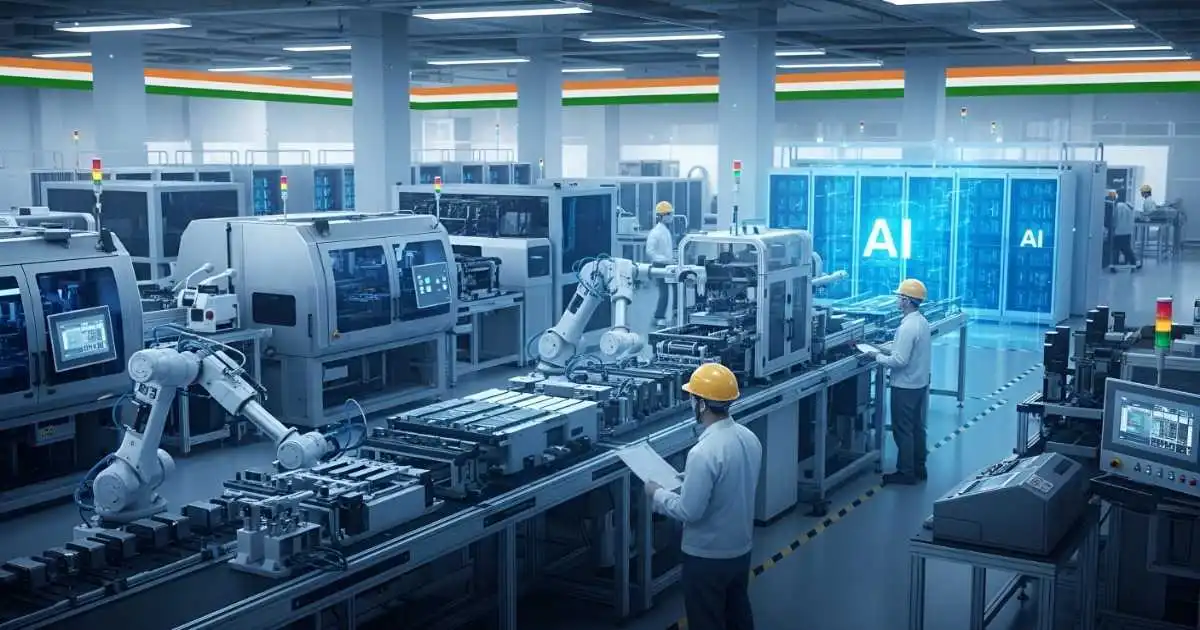
India's semiconductor journey just reached a major milestone. Micron Technology, one of the world's leading memory chip makers, is starting commercial chip production at its Sanand, Gujarat plant by the end of February 2026.
This marks the first large-scale semiconductor manufacturing activity in India, under the government's India Semiconductor Mission.
The numbers that matter
Micron's Sanand facility represents a fundamental shift in India's electronics strategy, with significant scale and investment:
Unlike test or trial runs, this is full commercial production. Real chips will be assembled, tested, packaged, and shipped from India, contributing directly to the global semiconductor supply chain and powering everything from AI servers to smartphones.
Who is Micron Technology?
Micron is a U.S.-based semiconductor giant that manufactures three main types of memory chips.
- DRAM: Memory for computers, servers, and AI systems — the high-speed workspace for data processing
- NAND Flash: Storage for smartphones, laptops, and SSDs — where data lives permanently
- High-Performance Memory: Used in AI accelerators, data centers, and cloud computing infrastructure
Micron supplies chips to smartphone makers, laptop manufacturers, cloud providers, AI companies, and automotive firms — making it a key player in the global tech ecosystem. With operations in 17 countries, the company reported over $30 billion in annual revenue in 2025.
What's happening in India?
The Sanand facility represents a fundamental shift in India's electronics strategy. Unlike previous assembly operations that were primarily for domestic consumption, this plant will integrate directly into Micron's global supply chain.
Full Commercial Production
- Not a test run or pilot
- Real chips assembled in India
- Export quality standards
- Global supply chain integration
Strategic Location
- Sanand, Gujarat emerging as electronics hub
- Proximity to Foxconn, Tata Electronics
- Industrial infrastructure ready
- Government incentive zone
What kind of chips will be made?
This is not a full silicon wafer fabrication (fab) plant yet. Instead, the facility focuses on Assembly, Testing, and Packaging (ATMP) — a critical stage in semiconductor manufacturing.
Why ATMP matters
Chips made elsewhere, like Taiwan or the United States, need final assembly, testing, and packaging before use in devices. India will now handle this critical stage. This ensures high-quality chips ready for:
- AI servers requiring high-bandwidth memory
- Cloud computing data centers
- Premium smartphones with advanced storage
- Automotive electronics requiring reliability
Why this is a big deal
Reducing import dependency
India imports billions of dollars' worth of chips every year — over $15 billion annually. Local production brings two major benefits.
Saves Foreign Exchange
Reduces current account pressure and builds domestic value capture.
Strengthens Tech Security
Critical for defense, telecommunications, and strategic infrastructure.
Boosting AI and data centers
Micron's memory chips power AI servers, machine learning systems, and cloud platforms. India's domestic production positions the country strategically in the AI and high-performance computing sectors. This is especially important as data center capacity expands exponentially across the country.
Job creation and skill development
The project will create thousands of direct and indirect jobs across multiple professional categories.
- Engineers – semiconductor design and process
- Technicians – equipment maintenance and operation
- Quality Control – testing and reliability
- Logistics – supply chain and distribution
- Semiconductor Specialists – advanced packaging
- Operations – plant management and administration
Attracting global investments
Micron's investment signals confidence in India's tech ecosystem. This could potentially attract more chipmakers, electronics manufacturers, and data center projects. Foxconn, Tata, and Applied Materials have already announced expansion plans following Micron's commitment.
Global and strategic context
The semiconductor industry has become highly strategic after several global disruptions.
Supply Chain Vulnerability
Automakers halted production due to chip shortages, revealing over-concentration in East Asia.
Technology Decoupling
Export controls on advanced chips forced diversification of manufacturing bases.
Risk Mitigation
Over 90% of advanced chips made in Taiwan — a single point of failure for global tech.
Countries worldwide are now diversifying chip production. India emerges with distinct advantages.
A Politically Stable Alternative
Democratic governance, rule of law, and non-aligned strategic posture.
A Large and Growing Tech Market
World's second-largest internet user base, fastest-growing data center market.
A Reliable Manufacturing Destination
Production-linked incentives, infrastructure investment, and skilled workforce.
What this means for the future
If successful, India's semiconductor journey could expand significantly in the coming years.
Future Trajectory
While India is not yet at Taiwan or South Korea's advanced fabrication level, this is a historic first step. It lays the foundation for a self-reliant semiconductor ecosystem that can support everything from defense electronics to consumer gadgets.
Final analysis
Micron's commercial chip production in India is more than just a business move. It represents a strategic milestone for India's technology future. By producing memory chips domestically, India strengthens its role in the global semiconductor supply chain, creates high-skilled jobs, and positions itself as a major player in AI, cloud computing, and electronics manufacturing.
For investors, this signals the beginning of India's semiconductor story — a multi-decade opportunity as global supply chains reconfigure. For engineers and students, it opens unprecedented career pathways in a field previously dominated by East Asia and the West. For the average consumer, it means greater supply chain resilience and potentially more competitive electronics pricing over time.
The chips fabricated elsewhere may be designed in California or Taiwan. But starting February 2026, they will be finished, tested, and certified in India. This is a small but critical step toward technological sovereignty and economic transformation.