Introduction: Two Competing Visions of Android
Here's the thing about Android in 2026: it's no longer one market. The Android flagship space has split into two distinct philosophies with fundamentally different priorities.
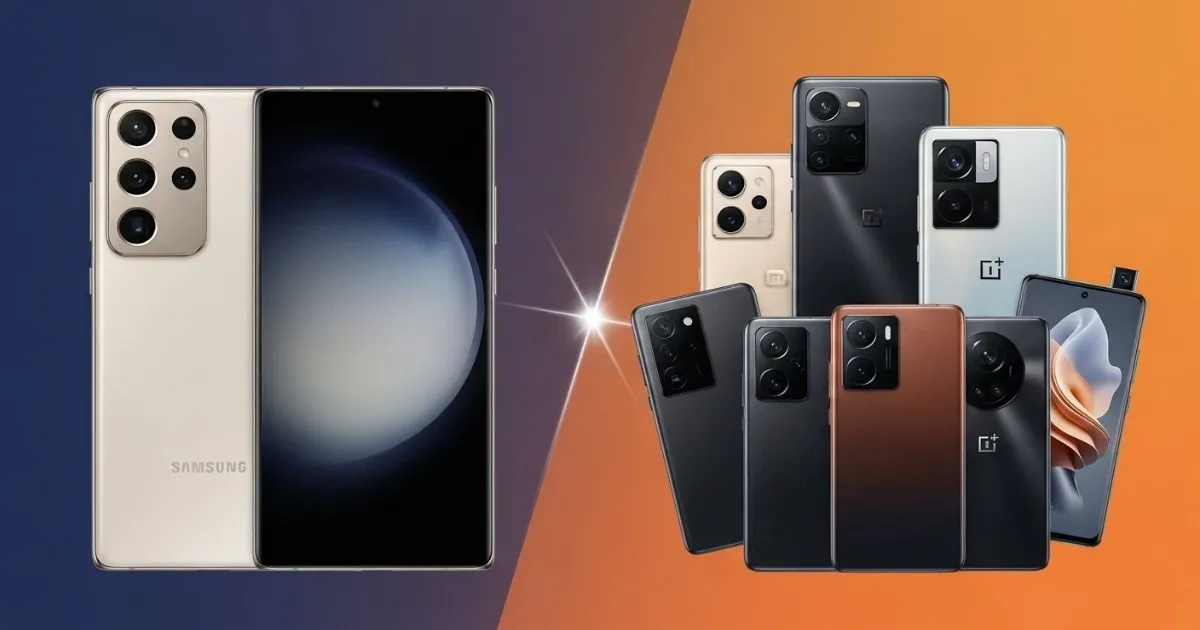
On one side sits Samsung, the global heavyweight building an integrated ecosystem of phones, tablets, watches, and laptops designed to work seamlessly across borders. On the other side, a coalition of Chinese manufacturers—Xiaomi, vivo, OPPO, Honor, and OnePlus—are pushing hardware boundaries with innovations Samsung won't touch: 120W charging, continuous optical zoom, and silicon-carbon batteries that last days.
This isn't about which is "better." It's about which philosophy aligns with how you actually use a phone.
Part 1: The Two Paths Defined
Samsung's Global Ecosystem Strategy
Samsung's approach in 2026 is best understood as ecosystem-first. The Galaxy S26 Ultra isn't designed to win spec sheet battles—it's designed to be the center of a digital life that includes your watch, your tablet, your laptop, and your earbuds.
The philosophy is simple: once you're in the Samsung ecosystem, leaving becomes genuinely painful. Your messages sync across devices. Your clipboard works everywhere. Your Galaxy Buds seamlessly switch between phone and tablet. Your Samsung Notes are available on every screen.
This integration creates a moat. A Samsung phone user who buys a Galaxy Tab isn't just buying a tablet—they're buying a second screen that already knows them. Call continuity, file sharing, and even using your phone as a toolbar while drawing on your tablet become second nature.
The trade-off: Samsung's hardware decisions sometimes look conservative next to competitors. Charging speeds max out at 45W when Chinese flagships push 120W. Battery capacity sits at 5,000mAh when others pack 7,000mAh. But Samsung argues this is intentional—prioritizing battery health and thermal management over headline numbers.
The Chinese Hardware Innovation Path
Xiaomi, vivo, OPPO, and Honor play a different game entirely. Their approach is hardware-first—pushing component technology faster than anyone else.
Want continuous optical zoom from 3x to 10x? Xiaomi's 17 Ultra delivers. Want 7,000mAh battery capacity in a phone that still feels reasonable? OPPO's Find X9 Pro has it. Want 120W charging that fills your phone in under 20 minutes? Multiple Chinese flagships offer it.
The Chinese manufacturers treat smartphones as platforms for component innovation. They're not afraid to experiment with variable aperture cameras, under-display cameras, or satellite connectivity features that Samsung waits to see mature.
The trade-off: Software support is inconsistent. Where Samsung promises 7 years of updates, Chinese flagships typically offer 3-4 years. International network band support can be spotty. And the deep Google services integration that global travelers need sometimes requires workarounds.
Part 2: The Six Decision Dimensions
1. Camera Philosophy: Versatility vs. Specialization
Samsung Galaxy S26 Ultra: The dual telephoto setup (3x and 5x optical) remains the most versatile zoom system available. The 200MP main sensor with wider f/1.4 aperture captures significantly more light than last year's model. For professional creators, Expert RAW mode offers 16-bit output and Log video recording. The camera does everything well—but it's not the absolute best at any single thing.
Chinese flagships: Each brand has carved out a specialty:
- Xiaomi 14 Ultra: Leica tuning delivers distinctive, contrasty images with character that divides opinion
- vivo X300 Pro: The 85mm portrait lens with蔡司镀膜 produces professional-grade people photography
- OPPO Find X8 Ultra: 6x optical zoom reaches 135mm equivalent—concert territory
- Honor Magic8 RSR: 200MP 125mm periscope for extreme telephoto reach
If you know exactly what you shoot—portraits, concerts, street photography—a specialized Chinese flagship will outperform Samsung. If you need one camera that handles everything reasonably well, Samsung wins.
2. Performance Philosophy: Peak vs. Sustained
Snapdragon 8 Elite Gen 5 powers both camps, but the tuning differs.
Samsung's "for Galaxy" chips are optimized for sustained performance—the phone should run as fast after two hours of use as it does in the first two minutes. Thermal management prioritizes consistency over peak benchmark scores.
OnePlus 15 runs the same silicon but emphasizes gaming performance, with a 165Hz display and aggressive cooling that maintains frame rates during extended sessions.
The Pixel 10 Pro XL's Tensor G5 takes a third path—prioritizing AI workloads over raw GPU performance. It's slower in games but more efficient at on-device AI tasks.
Real-world truth: Android Authority's testing shows that last-gen flagships still play today's games at essentially the same frame rates as new ones. The performance gap between generations has narrowed to the point where most users won't notice.
3. Battery and Charging: Conservative vs. Aggressive
This is where the philosophical divide is starkest.
| Brand | Typical Capacity | Charging Speed | Philosophy |
|---|---|---|---|
| Samsung | 5,000 mAh | 45W wired | Battery longevity, thermal safety |
| Xiaomi | 6,000-6,500 mAh | 90W wired | Fast top-ups, convenience |
| vivo | 6,000+ mAh | 120W wired | Maximum speed |
| OPPO | 7,000+ mAh | 80W+ wired | Silicon-carbon capacity play |
| OnePlus | 6,000+ mAh | 100W wired | Speed + capacity balance |
Samsung argues that 45W charging with sophisticated battery health management delivers better long-term value—their batteries are designed to retain 80% capacity after more cycles. Chinese manufacturers counter that faster charging and larger batteries make the trade-off worthwhile.
The silicon-carbon shift changes the equation. Several Chinese flagships now use silicon-carbon battery technology, offering higher energy density without increasing physical size. The OPPO Find X9 Pro reportedly delivers two to four days of moderate use.
4. Software Support: Certainty vs. Uncertainty
Samsung's seven-year update promise is unmatched in the Android world. A Galaxy S26 Ultra bought in 2026 will receive security patches until 2033. That's a genuine commitment to longevity.
Chinese flagships typically offer 3-4 years of OS updates and 4-5 years of security patches. For users who upgrade every two years, this doesn't matter. For those keeping phones 4+ years, it's a meaningful difference.
Update delivery matters too. Some manufacturers push Android updates months after release. Samsung has improved dramatically, often delivering new Android versions within weeks of Google's Pixels.
5. Ecosystem Integration: The Samsung Advantage
This is Samsung's unassailable strength.
- Galaxy Watch 8 Classic: Blood pressure monitoring, ECG, and sleep apnea detection work fully only with Samsung phones.
- Galaxy Tab S10 Plus: Call continuity, clipboard sync, and "use phone as toolbar" in Samsung Notes create genuine workflow benefits.
- Galaxy Buds 3 Pro: Samsung Seamless Codec delivers higher fidelity audio, and smart device switching works seamlessly across Samsung devices.
- Galaxy Book4 Edge: Multi Control lets you control your phone with mouse and keyboard. Storage Share mounts phone storage in Windows File Explorer. Quick Share moves files effortlessly.
No Chinese manufacturer offers anything approaching this integration. You're buying a phone, not an ecosystem.
6. Global Usability: Samsung's Hidden Advantage
For international travelers, Samsung's global network support is genuinely valuable.
The Galaxy S26 Ultra supports all global 5G bands. It works in New York, Tokyo, and Berlin without compromise. System languages cover 127 options. Real-time translation supports 64 languages. Official service centers exist in 147 countries.
Chinese flagships sometimes cut network bands to reduce costs, which means connectivity issues when traveling. Google services integration can be inconsistent. Warranty support outside China is limited.
If you travel internationally regularly, this alone may justify the Samsung premium.
Part 3: The OnePlus Exception
OnePlus deserves special mention because it sits in the middle.
The OnePlus 15 at $899 offers:
- Snapdragon 8 Elite Gen 5 performance
- Massive battery with 100W charging
- 165Hz display
- Clean OxygenOS software
- Better global band support than other Chinese brands
The trade-off is camera quality—the DetailMax engine hasn't yet matured to compete with Google or Samsung. But for users who prioritize battery and performance over photography, OnePlus offers the best value in the flagship segment.
Part 4: Decision Framework by User Type
Choose Samsung Galaxy S26 Ultra if:
- You're an international business traveler. Global network bands, worldwide service centers, and DeX desktop mode matter.
- You're invested in the Samsung ecosystem. Already own Galaxy Watch, Tab, or Buds? The integration benefits are real and daily.
- You keep phones 4+ years. Seven years of updates means your S26 Ultra will still be secure in 2033.
- You need the S Pen. The only flagship with a built-in stylus, still valuable for note-takers and creators.
- You want predictable excellence over experimental features. Samsung's conservative approach means fewer surprises—good and bad.
Choose a Chinese Flagship if:
- You're a photography specialist. If you know exactly what you shoot, vivo's portraits, Xiaomi's Leica colors, or OPPO's zoom will outperform Samsung.
- You prioritize charging speed. 90W, 100W, or 120W charging transforms how you think about battery life.
- You want the absolute latest hardware. Continuous optical zoom, silicon-carbon batteries, and variable aperture cameras appear on Chinese flagships first.
- You're on a tighter budget. Xiaomi 14 Ultra at ~$900 offers 90% of the flagship experience for significantly less.
- You upgrade every 2-3 years. Software support windows matter less when you're not keeping phones long-term.
Choose OnePlus 15 if:
- Battery life is your absolute priority. The massive capacity and 100W charging are best-in-class.
- You're a mobile gamer. 165Hz display and excellent thermal management deliver sustained performance.
- You want flagship performance at a mid-range price. $899 undercuts Samsung and Google by hundreds.
- You don't prioritize camera quality. The OnePlus camera is fine for social media but lags behind competitors.
Part 5: The Features That Actually Matter in 2026
Yahoo's 2026 analysis cuts through the spec sheet noise:
Anti-reflective coatings matter more than peak brightness
Samsung's Galaxies and iPhone 17 lead here—a screen with 1,800 nits and good coating beats 3,000 nits without it.
Sustained performance beats benchmark scores
A phone that stays cool under load is more useful than one that peaks then throttles.
Battery efficiency beats battery size
A 5,000mAh battery in an optimized phone can outlast 7,000mAh in a poorly optimized one.
Camera consistency beats megapixel counts
Reliable moving-subject capture and predictable results matter more than resolution.
Timely updates beat long promises
Seven years of updates means nothing if each one arrives six months late.
Part 6: The Verdict
The choice between Samsung's ecosystem and Chinese hardware innovation isn't about finding the "best" phone—it's about matching philosophy to priorities.
Samsung Galaxy S26 Ultra is the right choice if you value integration, longevity, and predictable excellence. It's not the fastest-charging phone, not the most innovative camera, not the most aggressive performer. But it's the most complete, and it connects to a ecosystem that genuinely enhances daily use.
Xiaomi 14 Ultra, vivo X300 Pro, OPPO Find X8 Ultra are right if you're a photography enthusiast who knows exactly what you want to shoot. Each specializes in ways Samsung doesn't.
OnePlus 15 is right if you want flagship performance and battery life without paying flagship prices, and camera quality isn't your priority.
Google Pixel 10 Pro XL deserves mention as a third path—the software-and-AI option that prioritizes consistency and computational photography over both ecosystem and hardware specs.
The 2026 flagship market is mature enough that there are no wrong answers—only answers that fit different lives. Choose based on how you actually use a phone, not how its spec sheet compares to competitors.
Related Guides
- Best Premium Smartphones to Buy in 2026 (Performance + Camera + Battery Ranked)
- Is Expensive Flagship Technology Really Worth It? Honest Buying Guide
- How to Save Battery Life on Flagship Phones — 2026 Working Methods
- How to Choose the Best Camera Phone for Photography in 2026
- 5 Things You Must Check Before Buying a €1000+ Smartphone
- Why Flagship Phones Are Getting More Expensive Every Year
- Battery Health Tips for Modern Fast-Charging Smartphones