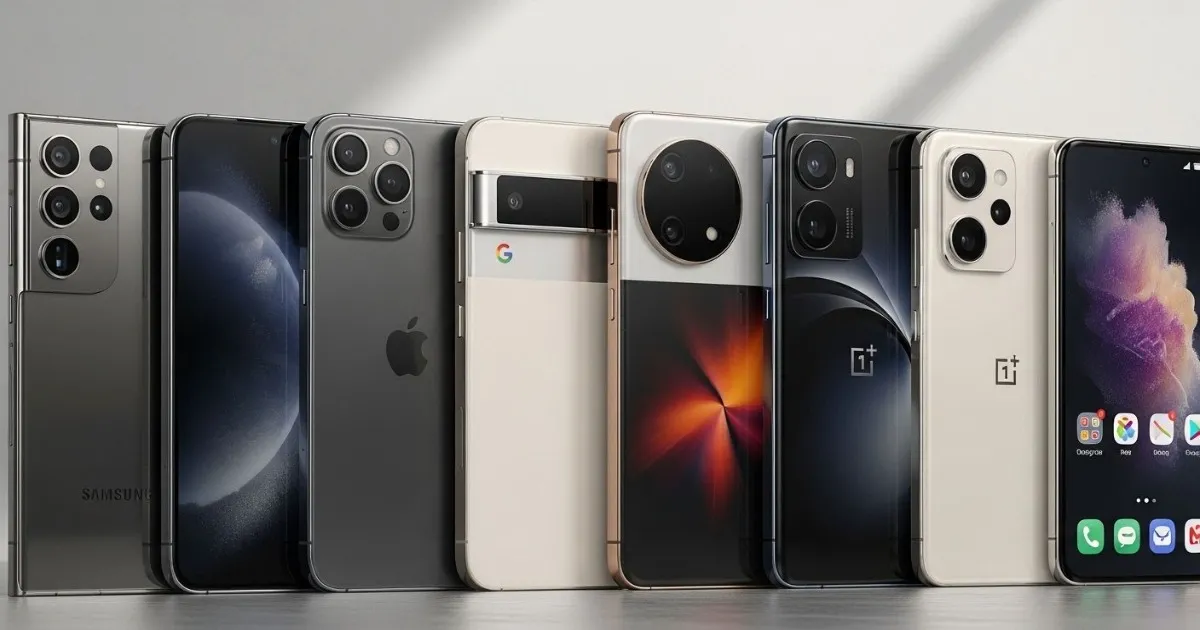
Introduction: The Flagship Race in 2026
Walking through the flagship smartphone aisle in 2026 feels less like shopping for hardware and more like choosing a digital lifestyle. The specs matter less than they used to. What matters now is how a device fits into how you actually live.
Here's the thing about choosing a premium phone in 2026: it's genuinely harder than it should be, not because the options are bad, but because they're good in such different ways. A few years ago, one device usually dominated everything. That's no longer true.
Today's flagships force you to decide what matters most. The best camera phone isn't the best gaming phone. The longest battery life doesn't come with the most versatile zoom. And the most polished software experience might leave you wanting more raw power.
This guide ranks the top premium smartphones available in 2026 based on three criteria: performance, camera quality, and battery life. Rankings draw from professional testing across multiple outlets including GSMArena, DXOMARK, AnandTech, and trusted YouTube technical reviewers who spend weeks with these devices.
How We Rank
Our evaluation weights three categories:
- Performance (30%): Real-world app loading, gaming frame rates, thermal management during sustained use, and benchmark consistency rather than peak scores
- Camera (40%): Daylight and low-light image quality, zoom versatility, video stabilization, color accuracy, and processing consistency across all lenses
- Battery (30%): Real-world screen-on time across mixed usage, charging speeds, and power efficiency under load
Each device was evaluated based on comprehensive testing from professional reviewers who used each phone as their primary device for at least one week. Rankings emphasize real-world experience over synthetic benchmarks.
The Top Premium Smartphones of 2026
1. Samsung Galaxy S26 Ultra – Best Overall Flagship
Starting Price: $1,299 (256GB)
Tech: Snapdragon 8 Elite Gen 5, 6.9" QHD+ Dynamic AMOLED 2X, 5,000 mAh, 60W wired charging
Samsung's latest Ultra is the baseline everyone else is measured against. Not because it's the most exciting—it rarely is—but because it does everything well.
What stands out most is the dual telephoto setup (3x and 5x optical). Most phones give you one zoom lens and call it done. Samsung gives you two, and the flexibility shows when you're composing shots at a concert or sporting event. You frame naturally rather than digitally cropping and praying.
Walk around with this for a week and you'll notice two things. First, the Privacy Display actually works—reading messages on crowded trains no longer feels like public broadcasting. Second, sustained gaming performance doesn't degrade after twenty minutes. The thermal management improvements matter more than peak benchmark numbers.
Industry reviewers generally agree this device leads in imaging versatility. The trade-off is processing time—capture multiple shots in quick succession and you'll wait a beat for the image pipeline to catch up. For most users, it's barely noticeable.
2. Apple iPhone 17 Pro Max – Best for Video and Ecosystem
Starting Price: ~$1,322 (256GB)
Tech: A19 Pro (2nm), 6.9" Super Retina XDR, ~4,683 mAh, 30W wired / 25W wireless
There's a psychological barrier here for anyone considering switching ecosystems. The iPhone 17 Pro Max isn't designed to convert Android users—it's designed to keep Apple users exactly where they are.
The engineering decision that matters most: uniform high-resolution sensors across all three rear lenses. This means video quality remains consistent when switching focal lengths. No Android phone matches this. Watch any comparison footage and you'll see what reviewers mean when they say the iPhone "just works" for video.
Use this for a week and you'll stop checking your battery percentage. That's new for iPhone users. The aluminum chassis also runs notably cooler during extended use—a small detail that changes how the phone feels in hand during summer months.
Still photography tells a different story. In direct comparisons, the best Android cameras capture more detail in challenging light and offer greater zoom flexibility. But the images Apple produces are consistently natural, and for most users, that matters more than winning spec comparisons.
3. Xiaomi 17 Ultra – Best Camera Phone
Starting Price: Premium pricing (higher than last year's model)
Tech: Latest Snapdragon flagship, Leica-tuned quad camera, silicon-carbon battery
This is a strange device to recommend to normal people. It's expensive, the software experience isn't as polished as Samsung or Apple, and it makes trade-offs that casual users will find frustrating.
What makes it special: continuous optical zoom from roughly 3x to 10x. You can smoothly transition between focal lengths with no quality drop. No other phone does this. Review footage shows the difference immediately—zooming with the Xiaomi feels like a camera lens, not digital guesswork.
Take this to a museum or gallery and you'll understand why photographers love it. You can capture detail on distant paintings, then switch to close-distance focusing on texture without moving. The processing delays between shots will annoy you, but the results will make you forget.
Leica's tuning produces images with distinctive character—contrasty, intentional, sometimes too aggressive. You'll either love the look or wonder why colors don't look "normal."
4. Google Pixel 10 Pro XL – Best Software and AI Photography
Starting Price: $1,199 (256GB)
Tech: Tensor G5 (3nm), 6.8" LTPO OLED (3300 nits peak), 5,200 mAh, magnetic accessory support
There's something refreshing about a phone that doesn't try to impress you with megapixel counts. The Pixel 10 Pro XL feels like it was designed by people who actually use phones rather than people who sell them.
Google's approach remains unique. Rather than upgrading sensors annually, they optimize processing to extract maximum quality from proven hardware. The results speak for themselves: the Pixel produces the most consistently excellent photos of any smartphone.
Shoot moving subjects—children, pets, athletes—and you'll see the difference immediately. Where competitors produce blur, the Pixel captures reliably. Low-light processing preserves detail while maintaining realistic exposure. The AI editing suite offers capabilities no competitor matches.
The hardware limitations show in zoom quality beyond 5x. If you regularly shoot distant subjects, Samsung or Xiaomi will serve you better. For everything else, the Pixel is unmatched.
5. OnePlus 15 – Best Performance and Battery Life
Starting Price: $899
Tech: Snapdragon 8 Elite Gen 5, 6.78" LTPO OLED (165Hz), massive battery, 120W wired charging
OnePlus has always understood something its competitors forget: not everyone cares about camera quality.
What stands out most is the battery capacity—significantly larger than any competitor. Combined with very fast charging, battery anxiety simply doesn't exist with this device. Reviewers consistently note they stop thinking about power management entirely.
Game on this for hours and you'll notice two things. First, frame rates remain stable—the thermal management works. Second, the display's touch sampling makes everything feel instantaneous. For general users, the performance is overkill, but that's the point. The OnePlus 15 never feels anything less than instantaneous.
The camera is where the value proposition shows its limits. It's fine for casual use—social media, quick shots, scanning documents—but anyone prioritizing photography should look elsewhere.
6. Samsung Galaxy S25 Ultra – Still a Contender
Starting Price: $1,049.99
Tech: Snapdragon 8 Elite (previous gen), 6.8" Dynamic AMOLED 2X, 5,000 mAh, 45W charging
This is the rational choice for anyone who doesn't need the absolute latest.
The gap between last year's flagship and this year's model is smaller than marketing departments would have you believe. In daily use, the performance difference is barely noticeable. The camera still produces excellent results.
Find this discounted and you're getting roughly 90% of the flagship experience for significantly less. The slower charging and older silicon matter less than the price difference suggests. For many users, this is the smarter buy.
Market Insight: Why Flagship Prices Keep Rising
Silicon costs have escalated. Analysts suggest that moving to advanced process nodes now requires substantially higher investment in research and fabrication. Manufacturers appear to be absorbing some costs while passing others to consumers.
Camera systems demand specialized engineering. The complex assemblies required for periscope zoom, sensor-shift stabilization, and multi-lens calibration involve manufacturing processes that entry-level phones avoid. Devices with continuous optical zoom carry meaningful engineering costs.
Ecosystem lock-in has matured. Manufacturers appear to be moving toward a strategy where flagships are designed primarily to retain users within their ecosystems. The iPhone's integration with Vision Pro, Mac, and iPad creates value beyond hardware.
The result: flagships now consistently cost over $1,200, while capable mid-range devices deliver perhaps 80% of the experience at half the price.
How to Choose
Samsung S26 Ultra: Complete flagship experience without trade-offs. Does everything well.
iPhone 17 Pro Max: For existing Apple users, video creators, and anyone valuing ecosystem integration.
Xiaomi 17 Ultra: For photography enthusiasts willing to accept compromises elsewhere. A specialist tool.
Pixel 10 Pro XL: For people who want great photos without learning photography. Software experience above hardware.
OnePlus 15: For gamers, power users, and anyone prioritizing battery life and raw performance.
Samsung S25 Ultra: The rational choice if significantly discounted.
Frequently Asked Questions
Which phone has the best camera?
For versatility: Samsung S26 Ultra. For consistency: Google Pixel 10 Pro XL. For pure capability: Xiaomi 17 Ultra.
Which has the longest battery life?
OnePlus 15. Often lasts well into a second day of heavy use.
Is the S26 Ultra worth upgrading from the S25 Ultra?
If you value Privacy Display and faster charging, yes. Otherwise, the S25 Ultra remains highly capable.
Does the iPhone 17 Pro Max have good battery life?
Yes. Finally competitive with Android flagships.
Which is best for gaming?
OnePlus 15. High-refresh display, excellent cooling, massive battery.
How accurate are specifications?
Some are based on announcements and projections. Actual shipping hardware may vary.
Conclusion
The 2026 flagship market is less about raw hardware competition and more about ecosystem strategy, computational photography, and sustained performance. No single device dominates every category because "best" now depends entirely on user priorities.
Samsung offers the most complete package. Apple delivers unmatched ecosystem integration. Xiaomi pushes imaging boundaries. Google proves computational intelligence can overcome hardware limitations. OnePlus demonstrates value-focused flagships still have a place.
Consider what matters most to you and choose accordingly.
Related Guides
- How to Save Battery Life on Flagship Phones — 2026 Working Methods
- Is Expensive Flagship Technology Really Worth It? Honest Buying Guide
- How to Choose the Best Camera Phone for Photography in 2026
- 5 Things You Must Check Before Buying a €1000+ Smartphone
- Why Flagship Phones Are Getting More Expensive Every Year
- Battery Health Tips for Modern Fast-Charging Smartphones
- Android Flagship vs Ecosystem Phones — Which Is Better for You?